Security incident report. A printable incident report — what happened, in sequence, in the officer's own words, with the detail that is still useful when somebody reads it two years later.
This is the paper version. SecureOptix does the same job on a phone, with the record filed against the assignment and the officer automatically.
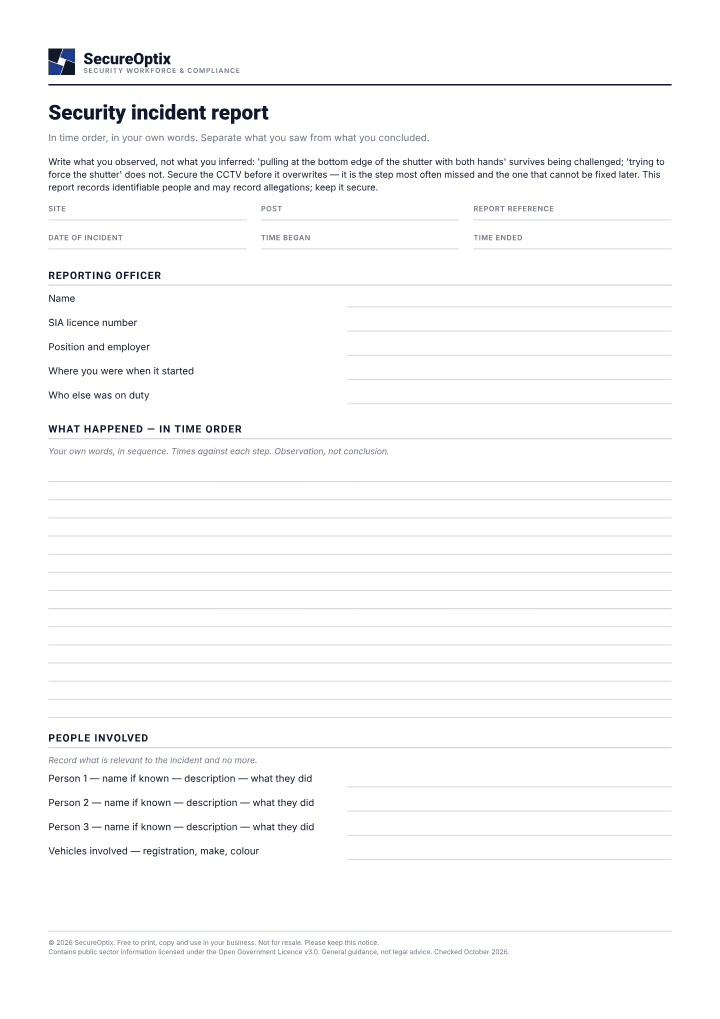
What is on the sheet
- Site, post, officer, and the date and time the incident began and ended
- A factual account in the officer's own words, in time order, separating what was seen from what was inferred
- People involved: descriptions, names where known, and what each did
- Action taken, who was called and when, and what the response was
- Police involvement, crime reference, CCTV secured and any property or damage
- Witnesses, evidence references, and a note that the report is personal data about identifiable people
Why this record matters
An incident report is written for somebody who was not there and will read it long afterwards — a client, an insurer, a court. That is why the account is in time order and in the officer's own words: a narrative written in sequence is checkable against CCTV and other accounts, and a narrative reorganised into categories is not.
Separating observation from inference is the discipline that makes a report credible. 'The male was trying to force the shutter' is an inference; 'the male was pulling at the bottom edge of the shutter with both hands' is an observation, and only the second one survives being challenged.
Securing the CCTV is on the form because it is the step most often missed and the one that cannot be fixed later. Systems overwrite, and a report that notes the incident and does not record that footage was preserved, by whom and where, has lost the best evidence there was.
The data protection note is not boilerplate here. An incident report names people, describes their behaviour and frequently records allegations about them — which makes it exactly the kind of record that must be held securely, shared only with those who need it, and kept only as long as the purpose requires.
Use it with
- Daily occurrence bookA printable daily occurrence book sheet — a contemporaneous, timed record of everything that happened on a shift, written to survive being read out in a courtroom.
- Use of force recordA printable record for an incident where physical intervention occurred — what led to it, what was done, what happened afterwards, and the reporting that has to follow.
- CCTV viewing and disclosure logA printable log of who looked at CCTV footage, why, and what was given to whom — the record that makes a surveillance system defensible rather than a liability.
- Patrol record sheetA printable patrol record — the route, the points checked, the times, what was found and what was done about it.
Read more on this
© 2026 SecureOptix. Free to print, copy and use in your business. Not for resale. Please keep this notice.
Contains public sector information licensed under the Open Government Licence v3.0. General guidance, not legal advice. Checked October 2026.